These birds like sweets. So their commonality is that they require ant moats for hanging. While orioles are supposed to like syrup, but I couldn’t find any. What I did find, though, was that woodpeckers, catbirds, and some finches like oranges and jelly as much as the orioles do.
Oriole Feeder
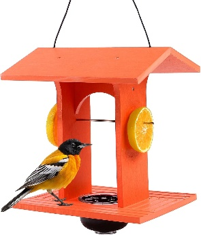
I bought a Kingsyard oriole feeder. Kingsyard no longer makes it, which is annoying. But it did introduce me to the quality of their manufacturing. What I loved about the kingsyard one is that the platform was wood(ish) and sturdy, the stakes for the oranges were sharp but wouldn’t cut you or birds, and the cups for the jelly were heavy so they seated well.
Though this one looks to be very different (the one I have is flat), it shows actually a better sense of the birds, setting the oranges sideways so they are easier to get to and making it possible for you to hang a slice of orange, rather than and entire half (which often molds before it’s eaten.)
The construction on this one appears to be like the Kingsyard one. The jelly container is larger than what I have – I have two fairly deep containers – so that may also be an improvement. What I discovered when I started to populate an oriole feeder is that you get more than orioles. Catbirds like jelly, as do some of the finches, and woodpeckers like the oranges.
Hummingbird Feeders
You start feeding hummingbirds in the northeast late in April and stop late in September (or when you notice your syrup level has stayed steady.) Since hummingbirds come to depend on your feeders for their lives, I generally leave my feeder out until well into the cold weather, just to be sure.
Google your local information about the beasts. It is mesmerizing to watch them dart about and sit to feed with their delicate long beaks. Also rather remarkable to observe how nasty these little things are as they defend their control of the feeder from all other takers.
Don’t fall for the con that you need to buy hummingbird syrup. Mix 1/4 cup of decent granulated sugar with 3/4 cups of hot water and you’re good to go.
Clean your hummer feeders every three days (or more in blazing heat). If you don’t, your syrup will ferment and drunken hummingbirds will kill themselves flying into everything in sight.
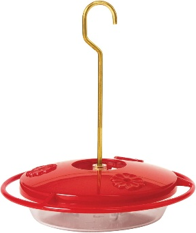
I have two feeders. I use this small one early since the population here generally builds slowly and the little one, though it says it takes a cup, realistically only takes half a cup of syrup because the rest spills. Then when I start to see hummingbirds running one another off, signalling to me that the interest in my feeder had grown, then I move to the big feeder
Aspects 153 Mini Hummingbird Feeder
When I decided to get a larger feeder, I wanted to go arty. I first bought some lovely hand blown glass balls, but they were quite small and quite difficult to clean. I still have them decorating a bowl, like apples that will never go bad.
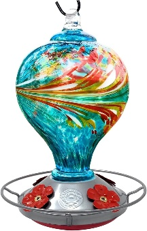
So then I moved on to this one. I’m quite happy with it. (I got a design with green and red and this one with blue and red is actually much more attractive.) Don’t let the mix of color put you off – the hummingbirds will go to the red in any case. The glass is thick and sturdy and what you receive looks very like what you see when you order it. The little birds like the perch ring that runs around the bottom, and the transparently fake little flowers around the edge do the job of pointing the bird to the hole from which the nectar will come. I hang both of the syrup feeders from ant moat hooks (this one now apparently comes with one), though I’ve noticed ants do not go up the birdfeeder pole with the squirrel baffle on it.
Open for more detail
The thing is easy to clean. You take it down and unscrew the bottom plastic reservoir. (The ring with the flowers simply sits on top of it.) Then it’s easy to use a hose to clear out the glass and drive any black mold that may have accumulated at the edge of the reservoir off. Once or twice a season I bring it (and the little one) in and soak them in the kitchen sink, certainly doing that before I store them for winter.
To put it together, you drop the ring with the flowers onto the neck of the bottle, fill the bottle while holding it upside down (duh, like a bottle) and then close the bottle by screwing the red reservoir plastic piece onto the stop like a cap. You flip it back over as you rehang it.
Ant Moats
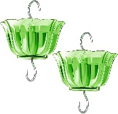
You’ll get ants with anything that is sweet, of course, so an ant moat is recommended. Kingsyard has some pretty ones.
I hang the oriole feeder from a bracket on the fence because it, like the hummingbird feeder, has no draw for the ominpresent and clever squirrels. Everything else in my garden is hung from a pole and kept safe from squirrels by a very effective baffle. From this configuration you get up to four hung feeders and the amusement of watching squirrels and chipmunks try to figure out how to defeat the baffle. And fail.