It has always amazed me that people take training a dog for granted and never think about training a cat. I’ve had cats since I was 8, and until I was in my forties, I accepted that I’d sometimes get enjoyable cats and other times get asshole cats.
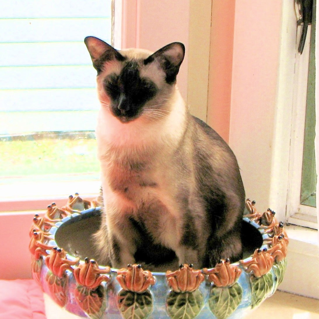
This is Rosemary, a Balinese cat who failed to look Balinese. I trained her and she was a lovely and amusing creature who really knew how to strike a pose.
When one particularly asshole cat lived to be 17 after falling out of a tree and breaking his hip, and another lived to be 21 in spite of being the runt of the litter, I decided to do something about it. First, I started buying cats whose breeds were generally congenial, but even that didn’t do it, so I moved on to training the damned things.
Five words and proof you’re the alpha cat.
That is all it takes.
Get Yourself in the Mindset
First, just sit down and think about how mother cats communicate with their kittens. There are no time-outs, nobody gets the cold shoulder or locked into a room without companionship. If the kitten bites the mother, the kitten gets swatted.
Now, when I say swatted, this is nothing for Peta to show up for. You are going to think about how hard a mother cat can swat and hit your kitten with about that much force and do it immediately.
The rules are otherwise the same as those for children:
- Be consistent.
- Be firm.
- Demonstrate what you want done.
It will only take you about two weeks to turn an asshole into a delight. One caveat: I know this works on kittens. I am not sure it works on grown cats, but go for it.
Word Number One: No

It’s a toss-up whether you teach No first or their Name. I go for No, because the sooner I stop getting bitten and scratched the better.
You’re going to use this word in such a way that it conveys your displeasure. That means the first time you correct the cat, you speak it almost conversationally and say it as you clap the animal on the ear.
As the behavior continues, and, yes, it will, you’ll increase the volume of your voice and start adding a bit of menace in. You can growl if you’d like, though I’ve never bothered. You will very, very slowly increase the sharpness of the slap, too, but not let it get to the point where an intervention is required.
Now, most cats will stop biting you (or scratching you or whatever) after about four iterations in one occurrence. If it goes on longer, just push the cat away. He or she will be back. Just, dear god, not right away.
From now on, I’m just saying They/Them rather than He/She. Get over it.
Word Number Two: The Cat’s Name
If you don’t have multiple cats, this is not important. But if you do, it is critical or every time you yell No, you’ll clear the room of both the guilty and the innocent. If you always use their name with a command, they learn the command as unique from any other cats in the house.
The easiest way to teach them their name is to say it when you put a plate of food in front of them. If you don’t feed wet food, a suitable alternative is to say their name whenever you pet them.
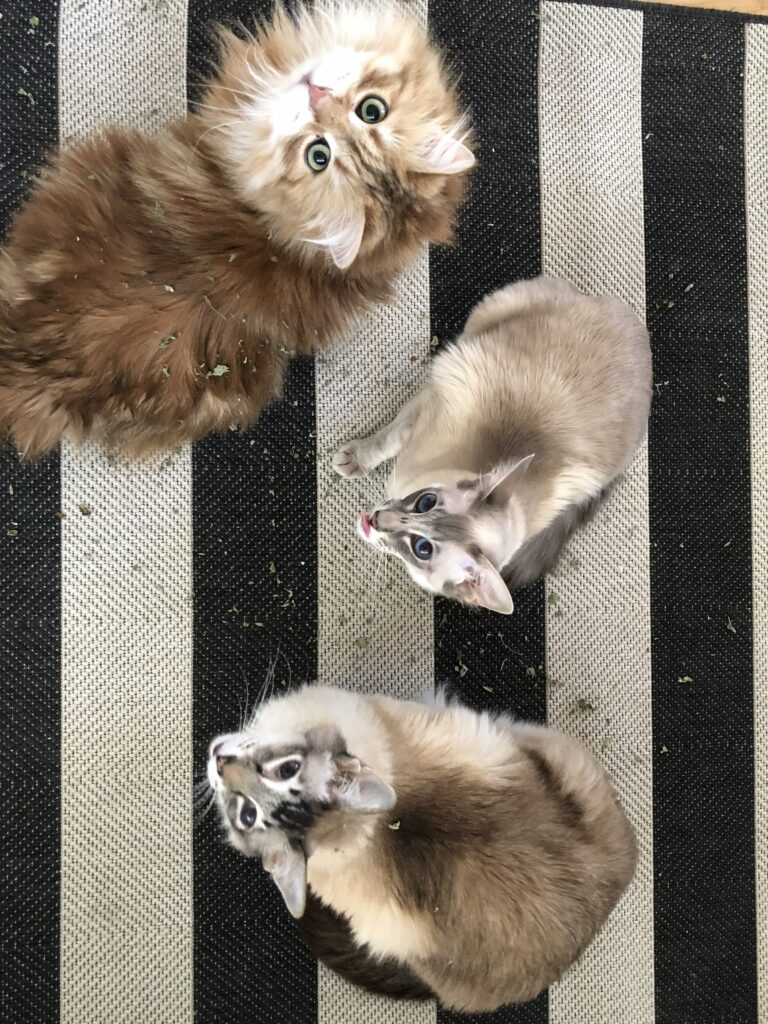
Clydesdale Annie, Tiger Jackson and Bobcat Charlie. Annie, Jack and Charlie all use different vowel sounds.
While it’s nice to be able to call a cat using their name, that’s not the point of this. The point of it is to accompany commands using the cat’s name:
No, Bruiser.
Always use the name when you are making a correction. Some cats will never understand the subtlety of the command with another cat’s name (I have one that leaves the room whenever anyone is scolded), but most will.
From here on in, our putative cat is named Bruiser.
Word Number Three: Down

I’ve got shit everywhere. And besides that, I’m with the 99% of the population who doesn’t want cat litter on the kitchen counters. That is where the command Down comes in.
The goal of this single word command is to cause a cat to get down from wherever they are, while you are able to sit comfortably across the room. That does not happen right away.
This is one of those actions that you have to spend some time demonstrating. When you see the cat somewhere you don’t want them, go over, lift them off and put them on the ground, saying Down, Bruiser when you pick them up, and Down, Bruiser again when you put them on the floor.
If they get right back up, repeat.
If they get up a third time in quick succession, you’re going to escalate. Early on in the training, escalation simply involves adding a clap to the ear before you pick them up (Down, Bruiser) and put them down (Down, Bruiser).
After you’ve been at it a week or so and it’s getting a little old, start adding some volume and gruffness to the Get Down Bruiser and just knock them off the counter instead of being polite about it.
I have had some hard-heads and that’s caused me to replace the gentle clap on the ear with a firm slap on the butt.
You know you’ve finished this training when you can say Down, Bruiser from across the room and hear the satisfying plunk of cat paws landing on the floor. If they do not respond immediately, I accompany the command with an arm gesture indicating the direction I want them moving. You’ll find that just motioning like you’re going to get up will generally do the trick if you’re being disobeyed.
Word Number Four: Out
You wonder why I include this word, but that’s because you’ve never yet had to search your house to find a kitten locked in a closet, mewling that sad but lamentably soft cry intended to draw your attention but incapable of doing so.
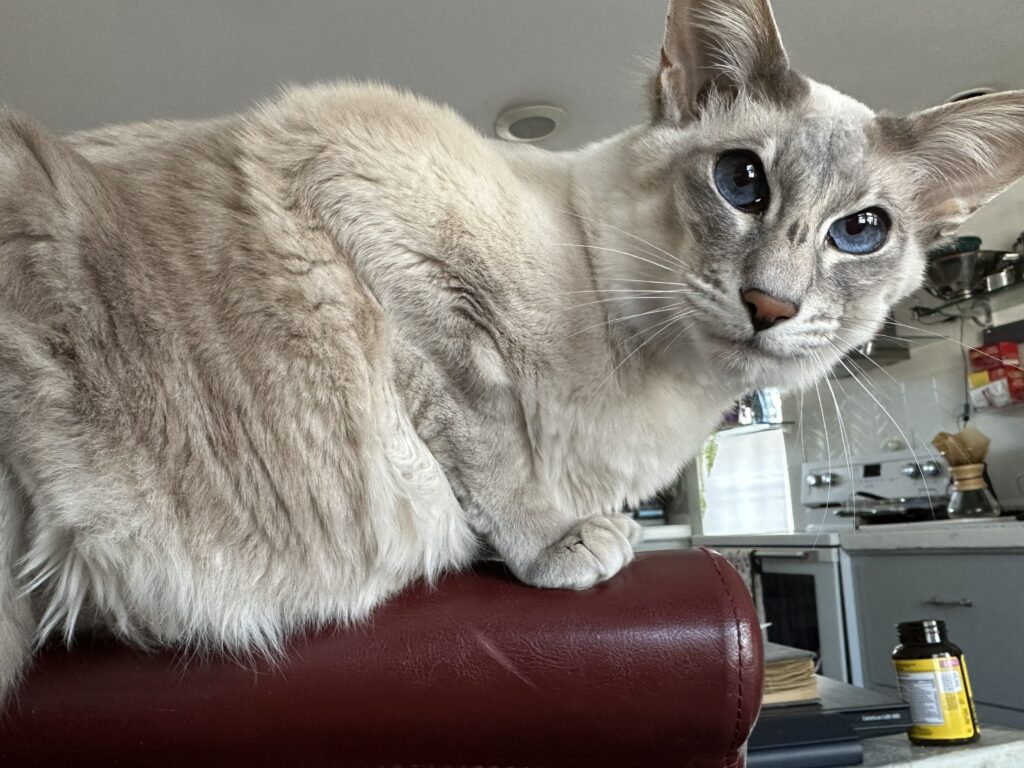
You use Out, Bruiser when you want a cat to leave the room they’re in. That can be to leave a closet whose door you want to close, or leave a bedroom you want to sleep in without any cats hogging the bed. Jackson, pictured, immediately gets to the floor and starts to roll beguilingly to get me to change my mind. In the end, though, he leaves the room.
Teaching this word is very like teaching Down, except that your access to the physical animal is likely to be awkward or impossible. If you can grab the cat, say Out, Bruiser as you pick it up and Out, Bruiser as you put it down in the other room and close the door.
Again, if the cat repeats, you get louder and then eventually add a gentle clap to the ear.
If the thing runs back into the room before you can get the door and hides, sigh, you’ve got the remote problem. I find noisy scare tactics are best for this. You’re going to flush them out toward the door with noise. That starts with closing off any other doors and then getting behind them. You’re going to flush them out like a pheasant in hunting season.
I walk to the other side of the room and start yelling Out, Bruiser while stamping my feet, stopping only when I see the little furry tail disappearing through the door. The longer I am forced to be at this, the angrier my voice becomes. I’ve upon occasion added a broom whose handle I rap on the floor.
But I live in a house. Don’t make your neighbors hate you.
You can use a vacuum cleaner to flush them, or can sweep the broom under the bed. The important thing is to increase the menace of Out, Bruiser as this lingers and to stop yelling and making noise the minute the cat is out of the room. I find a soothing coo, but Good Bruiser will work, tells the creature they’ve done something good.
If you’ve been at this and you have an asshole, close the door on the cat and then feed the other cats, leaving that one locked away. Pretend to do that even if you only have the one. Make noise doing it so the captive knows what they’re missing. That works nicely, too. When you come back to save them — wait at least five minutes – say Out Bruiser conversationally when you open the door. You can add, You missed your food for that stunt, loser, if you want to entertain yourself.
Word Number Five: Stop
Now, this is an optional word, but it’s one I like having to control things like a cat picking chunks out of its toes while I’m trying to eat supper.
You teach it very much as you teach the others, but by this time, it should take you much less effort to convey your meaning. (There is a final section about Recalcitrant Cats).
You say Stop, Bruiser to them, and then touch the offending action. In the case of that toe cleaning, you pull the foot out of the mouth gently, just saying Stop Bruiser, as if you were making polite conversation. You can also use No, but I find many cats think No is something they should leave the room for, while Stop is a kinder directive. I keep Stop very low key so it doesn’t produce any panic. (If you’ve done it right, No does produce some panic.)
If they start again, just say Stop, Bruiser again. That usually works. If it doesn’t, get up and remove the foot again, repeating Stop, Bruiser. I recommend against clapping the cat on the head for this because you don’t want the thing to have filthy feet – you just don’t want the feet cleaned while you’re eating.
On the Topic of Unintended Consequences
I had a friend who once so chastized her cat for pooping outside the box, that the cat pooped on her bathroom floor for the rest of his life. He learned that the catbox was a bad thing.
Don’t let this happen to you.
When you want to correct any behavior, think about how to communicate your wants to your creature. In general, never use No around the catbox. Cats do learn wrong and you can never explain that to them later. One of my cats answers to everyone’s name. I’ll never be able to fix that.
I confess to having a cat (Charlie) who poops in the box five or six times and then starts to poop on the floor. Each poop is about three feet from the last one. And when I start seeing poop in the downstairs hall, I know I have let the catboxes go too long.
This is behavior I have never figured out how to correct, because I’m pretty sure the correction is in my hands and not theirs. That cat simply wants his box changed every two days and I’m simply unwilling to do that. Never pees outside the box, so I take that as a win.
When you have an issue with a cat – like clawing the furniture – that has you working against an instinct, your best solution is redirection of the behavior. Buy a claw sharpening mat that lets them be cats. When they start to claw the furniture, lift them up saying No, Bruiser, and put them back down on the claw sharpening mat. Eventually you can use your old friend No, Bruiser to stop the furniture rending from another room.
You can see why I have No as word number 1.
The Alpha Cat
At this point, you should be able to get your cat off the counter by ordering from across the room, Down Bruiser. You should be able to stop them chewing on electrical wires by firmly saying No Bruiser. And you should be able to get Bruiser to leave the bathroom by suggesting Out Bruiser.
I casually talk to my cats now and they respond as if they were people. They get down and stop doing things because I’ve asked them to. I amuse myself by adding please and thank you and burying my keywords in sentences that are there only to amuse me. I may be a sad old woman, but I am also the Alpha Cat. Every cat in this house defers to me. That is what dog training does, and it is what your cat training does, too.
The Recalcitrant Cat
To this point, we’ve focused on how the mother cat communicates to her young. But there are other ways a cat learns in the wild and, in the wild, he does not always survive all of these learning experience.
Cats learn not to scratch or bite by being scratched or bitten. I do not recommend this. But I do recommend making sure your cat defers to you without question.
But if you’ve still got a cat who does not wholly believe you are Alpha, who still thinks it’s okay to bite you now and again, then you’ve got a cat who has no clear picture of how much larger and stronger you really are.
And its time for a demonstration.
We’ve all seen the video of the cat chasing the saint bernard dog out of the yard. Well, that thing’s an idiot and you may well have one, too, if they don’t believe you can take them without even trying.
Now, on the few occasions I have had cats that clearly didn’t understand that they really did have to do what I asked, I’ve demonstrated my power to them.
You could do it any way, but you don’t want to injure the cat, just scare the shit out of them and get across how fast they’d lose in a fight. My choice is pinning them at the neck. I get the cat on its back, hold the feet so I’m not scratched, put my hand around its throat, and squeeze gently until I see a bit of panic. Then I let go.
It has never taken more than two demonstrations. And afterward, they are much more pleased to do as I ask.
Epilog
I hope you trying training your cat because, honestly, it’s nice to have pleasant, affectionate cats that would die before they bit or scratched you.
Once you have such a docile creature, you’ll have something that’s easy to take to the vets and something that you can try any of these things on:
Nail Clipping
I clip their nails, always have. It is, frankly, the easiest way to safeguard your furniture. There are two things to know when you start out. One is that I have never had a cat that liked this out of the box. Someone may have cut their nails wrong and hurt them, so you may have a battle for a while. And two, cat claws are just like people nails: Only cut the white part and don’t go near the pink part.
Trim the front about once every two weeks (or when you can feel the prick of a sharp nail) and the back about every other time.
When you first do this, you may have a fight on your hands. I put the cat on its back and put a towel over the hind (kicking) feet. Then I work one front paw at a time, repelling any attempted biting with strong No, Bruiser. After a few times that doesn’t hurt, the cat will relax and this will be easy.
Grooming
If you have a long-haired cat, grooming is a necessity but may be contentious at first. I finally gave up all the fancy stuff and just groom my Siberian with a comb. She comes begging for grooming, but did not always. The secret at first was protecting myself with a towel over her legs and working very slowly and very gently, always cutting out the mats rather than trying to work through them. When she came to trust me, I didn’t have to do as much cutting.
Pill Taking
Never get liquid medication. Pills are easy with a docile cat. The important thing is to make sure the cat does not taste what you are giving them. To do that, you want it to land the pill way back in the throat. I grab the cat and take hold of the top of its head and basically open the cat up by pulling the head back. That will leave the lower jaw open. Then I drop the pill into the back of the exposed throat. Close the cat up and wait until they have swallowed. Done. This is critically important if you have a cat that needs daily medication. Just don’t give up if they are contentious at first. If you can manage this so they never taste what you’re giving them, the chore will be easy.