One of my great failings is assuming the best. I set out to groom 12 week old Annie with a plesant little wire brush and a sunny but lackadaisical approach to cat grooming: “Whenev” would be enough. That produced a cat with mats so tight and so dense that they resulted in some pain for her and an awful lot of redness where the fur pulled at the skin. It took me a full week to fix the damage I had done. Click to see how to address such an emergency.
My primary message to you is to start grooming a long-haired cat while she is a kitten and keep up with the knots. I found with Annie that the grooming is the most crucial while the cat is young. It actually gets easier to groom the cat as she ages. Some of that is that the cat is used to it and rather likes it, but some of it also appears to be that they do a better job of keeping mats at bay by themselves.
There are only two tools you need:
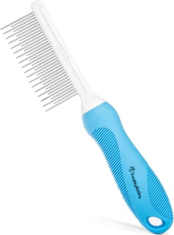
FreshlyBailey Grooming Comb
It is hard to see in that picture, but there are three features of that comb that make it so effective. The first is that it is a sturdy stainless steel with a soft, ergonomic handle that won’t tire your hand. The second is that the teeth on the comb are tight together. But the third and critical thing is that the teeth alternate between long and shorter, so that you can use the top of the tines to pick at a mat without pulling it out, and yet still have the tighter tines there to actually comb it out of the fur.
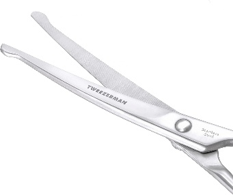
The primary tool you need to relieve seriously binding mats is a pair of sharp, cat-safe grooming scissors. The more difficult the cat is for you to handle, the more important “cat-safe” is. The scissor set I bought was actually a set of hair cutting scissor for people (marketed for cats). The thinning scissors rather gave it away. But the scissor I used consistently on Annie was the pair that had a curve that pointed away from the cat. The set I bought did not have the tip, but this pair does. It also has the curve and the 7″ scissor is likely what you need. Seems a bit expensive, but it’s about what I paid for the full set and I’ve never used any of the others. Were I to do it again, I’d buy these.
Even though the brand is Tweezerman.
Weekly or Daily
I used to groom Annie weekly when I had to corral her and force grooming upon her. Believe it or not, Annie comes to me each morning for her pill. Because she knows I will groom her. That could not be further from the relationship I thought we’d have over grooming when I first started out with her.
The secret with a long-haired cat, as it is with most things, is keeping up with it while it is still easy to do. After trying out all sorts of tools, I finally settled on the scissors and comb that do the whole job. The comb does the heavy lifting and the scissors are there for emergencies.
The worst mats occur in the fur on their chests. That eludes common sense for me – because you’d think washing that would be easy – but many long haired cats like Siberians don’t actually seem to wash like regular cats. I guess they know that that much fur will simply build up in their bellies and kill them. If I let too long go between groomings, Annie pulls big chunks of fur out herself. I find rings of orange tufts where she’s sat and deliberately done her own form of grooming. It’s unsightly, but I also tend to take it as a bad review of my grooming skills when I find those rings.
So keeping the fur on the chest mat-free is critical. The other places mats easily occur is where their legs join their bodies. Armpits and groins, both on the belly side and on the back side.
Triage
What I generally do is first use my hands to feel around to find out if there are any mats to be detangled. If there are, I go to them first. If they are small and fresh, I tease at them with the outside edges of the comb to loosen them and then eventually use the full comb to pull them out. I often have to work a single mat in several pieces to get the whole area clear. The area is clear when you can pass the comb down the whole section without any snag.
If you find a well entrenched mat, or one that’s in an area that’s already become red and sore, use the scissors to remove it.
Belly
Once the mats I could find with my hands are gone, I go after her belly first. I want to run the comb through all of her underside fur and her chest and around her neck. I position her on her back for this. Until the cat loves being groomed, which will eventually happen if you are careful never to hurt her, you may need to put a towel over her back legs to protect yourself. You can grab one of her forelegs with your hand to keep her on her back.
Bellies are more tender than backs, so move the comb more slowly over the belly than you would on the thicker back fur. Start in the armpits and groin, because that’s where you may have missed growing mats. Then comb around her throat and down through the fur on the front of her chest until all of those areas comb through smoothly. Once you’re pretty sure you have the mats out, run your comb slowly over the entire expanse of cat, right down to around her privates. You’re done when it’s an easy matter and you encounter no pockets of knotted fur.
Back
Doing a cat’s back is much easier than the belly. First of all, while there are mats, they are seldom as tight on the back as they can get on the belly, so they are less apt to be causing the animal pain. That said, they are often bigger mats.
Locate the mats with your hands if you can, but mats on the back are often pretty subtle. Then start with the strip of fur straight down the spine. Settle your cat comfortably sitting meatloaf style and start the comb at the top of her head, running it steadily down her back as if you were stroking her. You will encounter resistance. While this resistance is not any matting, it is loose and dense undercoat which will form mats if you don’t get it regularly out of there. As you encounter resistance, comb up the fur and lift your comb to bring the excess undercoat out. Clear the fur out of the comb and then go back down to continue combing. You’re done with that section when you can comb down her back without much resistance.
Sides
Now, flip the cat on its side with feet away from you. You’re going to comb through the fur from the spine to the belly, paying most attention to the areas around the legs and tail. Again, deal with any mats you can feel first, then slowly comb through the fur, removing undercoat as you collect it.
And finally, when you think you’re done, spend some time on the cat’s head making her happy. There is nothing that feels better to a cat than some nice gentle scratching along the side of the face and neck. The more you turn the end of this into a petting spree, the more the cat will want to cooperate next time.
So good luck.